
Australia's sunrooms, sleepouts and enclosed verandahs began as improvised answers to heat, illness and changing household needs. Before the next one disappears under an open-plan extension, it's worth asking what they were for, and what they might still be good for.
The property market talks about these rooms as a pleasant feature, noted in passing, somewhere between a selling point and a demolition line item, as is the case for the advertisement for 33 Edgar Street, Towradgi which gave a single line noting its existence, "charming rear sunroom creates an additional living space and overlooks the established garden". The agent then offers a potential buyer multiple pathways, "Renovate and restore. Expand and evolve. Or clear the canvas and create something entirely your own".
The first thing that comes to mind, is that the sunroom will be the first be absorbed in these scenarios. It’s an endangered room type, a relic of the past, but past home builders had the right idea. The sunroom is one of the few rooms in an older house that tells you the unique story of that family and how they spent their time. The room doesn’t have a specific purpose other than to use the most of natural light. That may be its best argument for survival.
There’s something quietly restorative about spending time in a room filled with natural light, and the benefits go well beyond aesthetics. Daylight helps regulate our body clock, keeping us more alert during the day and supporting better sleep at night. Exposure to sunlight is also associated with serotonin activity, which plays an important role in regulating mood and emotional wellbeing. Soft, evenly distributed daylight can make reading, drawing and other close-up activities more comfortable for the eyes. A thoughtfully designed sunroom brings these benefits into everyday life, creating a welcoming space to slow down, concentrate on something we enjoy and in doing so feel better than we would doomscrolling Instagram while watching TV in the living room.
A few months earlier, 52 Amos Street, Westmead offered two such spaces in one modest original brick house. The agent's copy singled out its wrap-around enclosed verandah providing additional living space, while inviting buyers to "renovate, extend, rebuild" with no mention of the sunroom, not even in passing. It was on the floor plan that I saw it had a sunroom which is 10m2 (5.7m x 1.8m) while that wrap-around enclosed verandah is a gallery of 16.4m2 (2.0m x 8.2m). The verandah connects to the undercover entertaining area and at some point this open space was closed in to create additional indoor space, which quite likely was used as a sleepout.
Architectural historian Nanette Carter traces the fascinating history of these spaces in her 2022 paper, The Sleepout. Whether a converted verandah, an enclosed balcony or a small freestanding structure, the sleepout was an everyday Australian experience in the 20th century.
As early as the colonial period, verandahs provided extra sleeping space for overcrowded households and often offered welcome relief from hot, uncomfortable bedrooms. By 1906, Australian newspapers were promoting open-air sleeping for its perceived health benefits, including as a way of separating family members suffering from illnesses such as tuberculosis. By the 1960s and 1970s, sleepouts were often used as children's playrooms and teenage retreats.
Although enclosed verandahs and sunrooms can look remarkably similar, they weren't always created for the same reasons. While sleepouts largely developed around the need for additional sleeping space, fresh air and relief from the heat, sunrooms placed greater emphasis on sunlight, health and leisure. Julie Collins's research on 1930s South Australia traces a fashion for sunlight as medicine. A 1937 headline in Adelaide's Advertiser announced a "new cult of the sun", and later that year The Mail advised readers to make the most of the sunroom as a healthy place for varied activities.
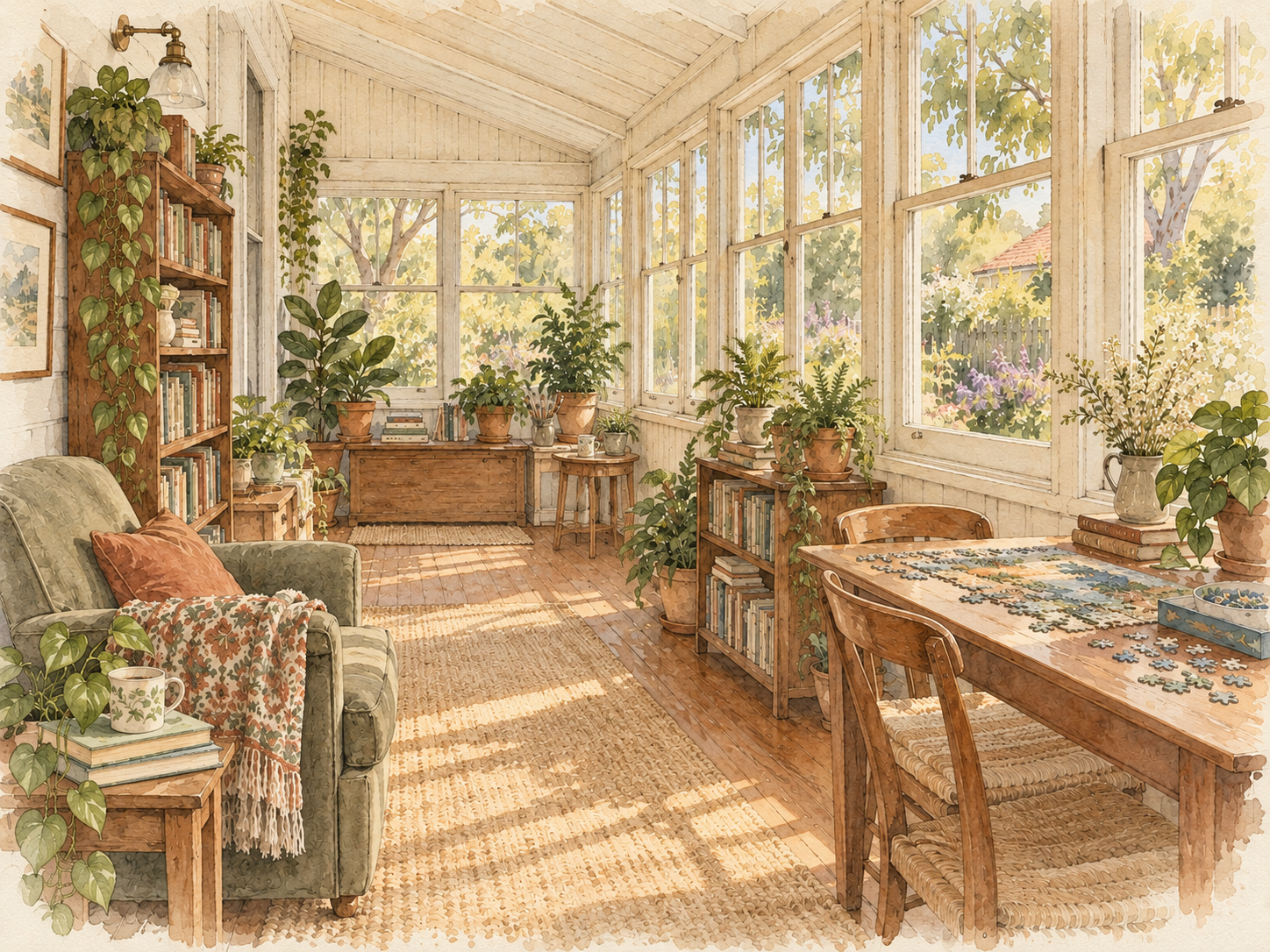
When I look at a sunroom, I picture a small library with a comfy armchair, a table where a jigsaw can stay half-finished for a month, a board game left set up, plants that finally get enough light and a view of the garden. As it turns out, my imagination isn't far removed from their original purpose. Collins identifies reading, writing, sewing and games among the activities sunrooms were designed for. A 1937 newspaper article even recommended furniture with dedicated storage for cards and games and a writing surface and space for a wireless. Nearly ninety years later, I'd happily use one for exactly the same things.
Unlike an open-plan living area, a separate sunroom can offer something increasingly valuable: a door you can close. The jigsaw stays unfinished, the board game remains set up between sessions and a child's half-built project doesn't have to be cleared away for dinner. Not everything needs to be tidied away or hidden from sight.
Interestingly, the Australian Government’s YourHome guide also recognises the value of sun-filled spaces, recommending carefully designed solar conservatories to capture warmth in cooler climates.
Of course, not every sunroom can or should be saved. Some older additions contain asbestos, lead paint or structural problems that make restoration more complicated than it first appears. When architect Emily Sandstrom renovated a 1930s bungalow in Marrickville, she demolished its asbestos sunroom while carefully preserving other original features. In contrast, Tribe Studio's renovation of a Roseville home incorporated an enclosed verandah into the renewed house, where the family's sons now have a space to practise piano. Two very different decisions, both showing that the value of an old space lies in understanding what it offers and whether it makes sense to keep it.
The more I learn about the humble sunroom, the more I want one. If a future home doesn't already have one, I'd seriously consider creating it as part of a renovation, paying attention to its orientation and how the sunlight moves through the space throughout the day and across the seasons. I can already picture a writing desk with a typewriter, and a comfortable corner where I can take breaks to crochet.
