
A generous backyard can grow food, shelter wildlife and bring people together. Before we build over it, perhaps we should consider everything it could become.
Give a real estate agent a generous block of land and the conversation often turns to subdivision, extensions or a second dwelling. Give me that same backyard and my imagination goes in two very different directions.
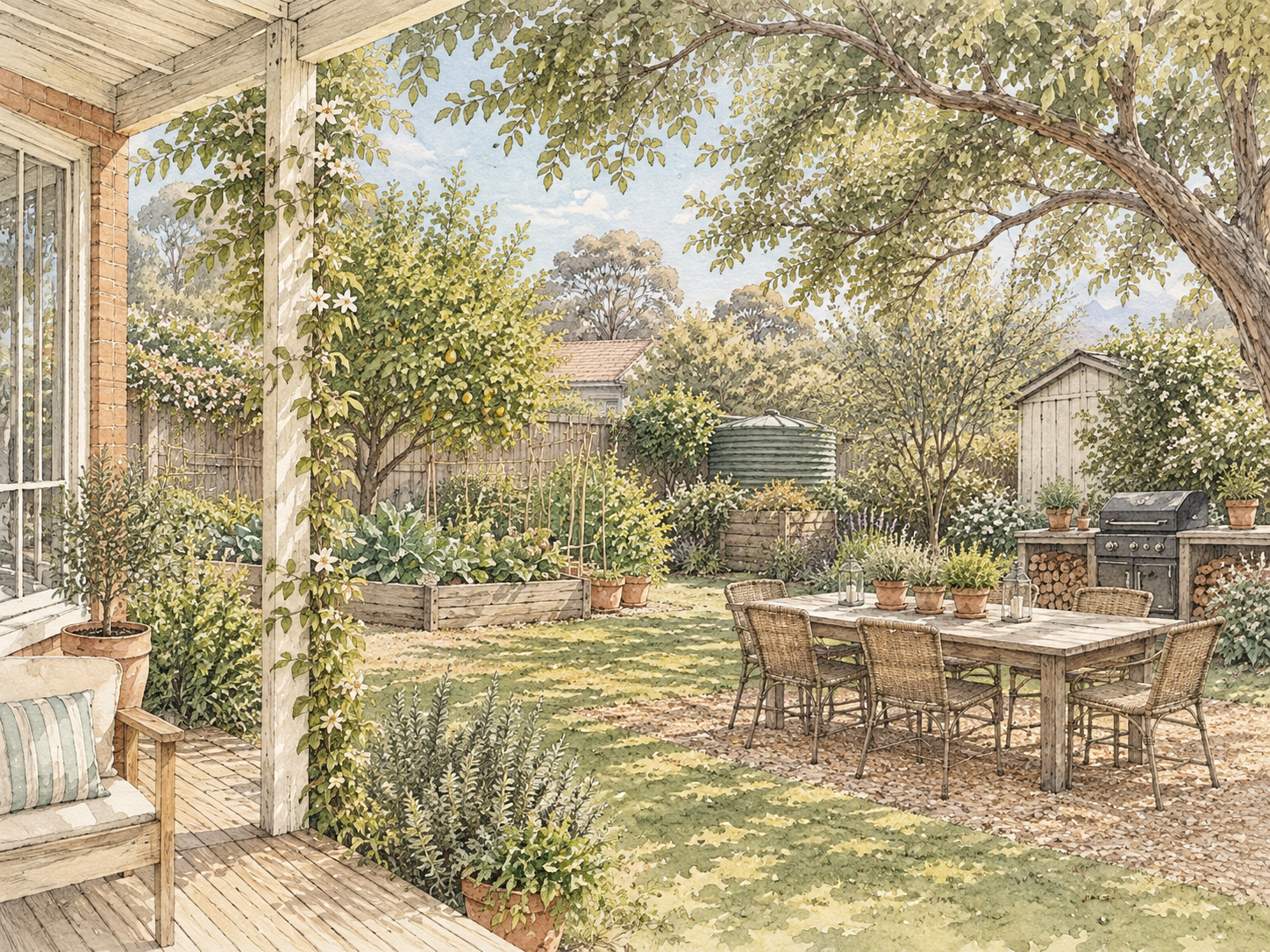
The first is a small suburban homestead. Fruit trees, vegetable beds, rainwater tanks, composting, native plants that draw in birds and pollinators, and a garden that becomes a little more self-sufficient with every passing season, perhaps even completely off-grid one day. It’s where we can grow food, learn practical skills and live a little more closely with nature, without having to move to the countryside.
The second is to go all in on entertaining. Perhaps a generous deck, a proper barbecue, even a swimming pool and a long outdoor table that seats far more friends than the dining room ever could. Or perhaps simply a table beneath a tree. What matters is the kind of backyard where gatherings become regular occasions even when there is no specific occasion, children spend entire afternoons outside and people stay talking long after the plates have been cleared. Bring back socialising like it's 1999.
And the lovely thing is that these two visions aren't mutually exclusive. A productive garden can be just as much a gathering place as a beautifully landscaped entertaining area.
18 Daveson Road sits on 1,472 square metres, and the listing includes an open fireplace, a shed and solar panels. Across town we have, 61 Glindemann Drive, Holland Park, a post-war house in original condition on a flat 612 square metre block.
The disappearing Australian backyard
I've noticed how much of the traditional Australian backyard has disappeared, even where blocks are still reasonably generous. Urban planning researcher Tony Hall documented this trend in The Death of the Australian Backyard, tracing it to the early 1990s as houses began occupying more of their blocks. In a Carina development completed in 2002, more than half the backyards were smaller than 50 m². As Hall observed, the block sizes were staying consistent in size but instead houses were growing thier footprints.
That's what caught my eye about 61 Glindemann Drive. Its 612 m² block isn't large by traditional suburban standards, but the modest 111 m² house leaves room for a proper backyard. Hall worried that larger houses were squeezing out trees, vegetable gardens, children's play and social gatherings. The best memories are often made in the backyard, celebrating birthday parties over the years, finding Easter eggs, playing backyard cricket, catching lizards, spinning goon bags on the Hills Hoist, the dads gathered around the barbecue holding beers and the mums gossiping while their children are screaming and playing in the grass. It seems a strange trade-off to gain more space indoors at the expense of the backyard, especially when so much of what makes a home memorable happens outside.
More than somewhere to hang the washing
As historian Andrea Gaynor recounts in Harvest of the Suburbs, these concerns aren't new. In 1976, Ian Halkett warned that shrinking yards could encourage more sedentary lives or greater reliance on public and commercial recreation. That same year, historian Hugh Stretton described residential land as "a classroom for work-skills, play-skills, nature study and environmental values". It's one of the best arguments for keeping a backyard I've found, and it has nothing to do with property values.
As Australia's post-war suburbs expanded, the backyard barbecue became something of a national institution. Magazines even published instructions for building your own brick barbecue. I particularly love how homemaker editor Eve Gye described the backyard as an "outdoor living-room", where families could eat, talk, relax and entertain. Even a small yard, she argued, could become a comfortable gathering place with some shade, plants and a barbecue. The idea was to make outdoor meals part of everyday life, rather than something reserved for special occasions.
For migrant families, backyards could offer another kind of connection. When University of Wollongong researchers Lesley Head, Pat Muir and Eva Hampel studied migrant gardens, they found an emphasis on vegetables among the Macedonian households they studied, and herbs and fruit among Vietnamese households, reflecting traditions brought from home. Other research into Greek and Vietnamese gardens in Marrickville found that growing familiar plants helped families maintain cultural connections and a sense of belonging. A backyard could be somewhere to gather around a table, but also somewhere to keep a little piece of home growing.
A different kind of backyard ambition
That brings me back to 18 Daveson Road in Capalaba. With 1,472 m² of land, solar panels already installed and a shed, it's exactly the sort of property that gets me imagining a more self-reliant way of living. Fruit trees, vegetable gardens, rainwater collection, composting and a workshop for making and repairing things. But before planting anything new, I'd want to understand what's already growing there. The Australian Government's YourHome guide encourages retaining established vegetation wherever possible. No new pergola can match a mature tree.
Of course, imagining a more sustainable suburban lifestyle is one thing. Actually making it work is another. In Wynnum, on Brisbane's bayside, Gardening Australia presenter Jerry Coleby-Williams has spent more than twenty years demonstrating what's possible. In 2003, he and his housemate Jeff Poole took on an older Queenslander on approximately 813 m² and transformed it into Bellis, a working example of food production, water conservation, renewable energy and biodiversity in an ordinary suburban setting.
Not every backyard needs to become another Bellis. Most of us won't grow 127 edible crops, and not every household wants to. But I do wonder why we so often look at a generous block through the lens of what could be built on it, rather than what could grow there and how we might grow alongside it.
